Wednesday, October 21, 2026

Wednesday, September 16, 2026
Chicago Multifamily Offer Terms: 8 Deal Points That Protect Sellers

The strongest multifamily offer is not necessarily the one with the highest headline price.
Earnest money, diligence, financing, buyer credibility and closing timing can materially change a seller’s actual outcome.
Tuesday, September 15, 2026
Why the Highest Multifamily Offer Is Not Always the Strongest

The highest multifamily offer is not always the strongest.
Earnest money, due diligence, financing, buyer credibility, appraisal exposure, closing timing and retrade risk can materially change the probability of a clean closing.
For apartment owners, the better decision is often the offer that balances value with execution certainty.
Wednesday, September 9, 2026
Chicago Multifamily Financing 2026: More Capital, Disciplined Leverage

The Chicago multifamily financing 2026 environment is improving, but apartment owners should distinguish between more available capital and easier leverage.
Banks, agencies, debt funds, and other lenders are competing more actively for commercial real estate loans. Multifamily originations are rising, credit spreads have tightened, and recent Federal Reserve survey data indicates that some banks are modestly easing multifamily lending standards.
At the same time, lenders remain disciplined on loan-to-value ratios, debt-service coverage, debt yield, and property-level cash flow.
For Chicago-area multifamily owners, that distinction matters.
More lenders willing to finance acquisitions can improve transaction liquidity. More refinancing options can also help owners approaching loan maturities. But buyers still need sufficient net operating income to support the debt.
In many transactions, DSCR or debt yield can limit proceeds before the lender's advertised maximum LTV becomes relevant.
That means today's financing environment affects more than borrowers. It can influence property value, buyer purchasing power, sale execution, and the decision to refinance, hold, or sell.
Multifamily Lending Activity Is Increasing
Commercial real estate lending improved materially during the second quarter of 2026.
CBRE reported that the number of commercial loans increased 11% year over year, while average loan size increased 5%. Multifamily loan spreads tightened by 15 basis points to 162 basis points on fixed-rate permanent loans.
At the same time, average multifamily leverage actually declined. Multifamily LTV averaged 63.3%, compared with 65.8% one year earlier.
That combination is significant.
Lenders appear increasingly willing to compete for good multifamily loans—but primarily through pricing rather than additional leverage.
The Mortgage Bankers Association reported a similar improvement in lending activity. Multifamily mortgage originations increased 8% year over year and 15% from the first quarter of 2026.
Depository institutions were particularly active, with commercial and multifamily loan originations by banks increasing 61% from one year earlier.
For apartment owners, the takeaway is relatively straightforward:
Capital availability is improving, but underwriting discipline has not disappeared.
Current Multifamily Mortgage Rates
As of September 8, 2026, CommLoan reported the following average multifamily mortgage rates from participating lenders:
| Loan Type | 5-Year | 7-Year | 10-Year |
|---|---|---|---|
| Bank | 6.25% | 6.77% | 6.90% |
| Agency | 5.92% | 5.91% | 5.93% |
| Agency SBL | 6.21% | 6.27% | 6.24% |
| CMBS | 7.03% | 6.98% | 6.68% |
These figures are market averages for comparison rather than loan commitments. Actual pricing depends on the property, borrower, leverage, loan amount, amortization, term, prepayment structure, and other underwriting considerations.
The important point is that debt remains considerably more expensive than it was during the exceptionally low-rate period preceding the recent tightening cycle.
Improved lender competition therefore does not automatically mean dramatically higher loan proceeds.
A lender may reduce its spread and offer more competitive terms, but the property still needs enough cash flow to support the requested debt.
Banks Are Returning to the Multifamily Market
One of the more constructive developments in 2026 has been increased participation from banks.
CBRE reported that banks represented approximately 30% of non-agency loan closings in Q2 2026, compared with 24% one year earlier.
Alternative lenders represented 38% of non-agency volume, life companies 21%, and CMBS lenders 11%.
Federal Reserve data provides additional evidence of improving credit availability.
In its July 2026 Senior Loan Officer Opinion Survey, the Federal Reserve reported that a modest net share of domestic banks had eased standards for multifamily loans during the second quarter.
However, there is an important qualification.
The Federal Reserve also found that multifamily lending standards remain toward the tighter end of their historical range.
That combination describes the current market well:
Credit is becoming more available, but lenders remain selective.
For borrowers, more competition creates additional financing options.
For sellers, it matters as well.
A larger lender pool can help qualified buyers obtain financing, reduce execution risk, and improve the probability that an otherwise sound transaction reaches closing.
More Capital Does Not Mean Maximum Leverage
The most important feature of the current Chicago multifamily financing 2026 market may be what lenders are not doing.
They are not broadly returning to the aggressive leverage assumptions of the previous low-rate cycle.
CBRE reported that average multifamily LTV declined to 63.3% from 65.8% even as lending activity increased.
Across CBRE's commercial lending activity:
- Average DSCR increased from 1.34x to 1.43x
- Average debt yield increased from 9.7% to 10.2%
- Average commercial LTV declined from 60.8% to 59.6%
Those are signs of disciplined underwriting rather than aggressive credit expansion.
For an apartment owner considering a sale, this is important because a lender's stated maximum LTV is only one limitation on a buyer's financing.
Actual loan proceeds can also be constrained by:
- Debt-service coverage ratio
- Debt yield
- Interest rate
- Amortization period
- In-place NOI
- Vacancy assumptions
- Management expense
- Replacement reserves
- Property taxes
- Insurance
- Capital expenditures
A lender may advertise financing of up to 70% or 75% LTV.
That does not mean every property will actually support that amount of debt.
How DSCR Can Limit a Buyer's Loan
Consider a simplified acquisition example.
Assume:
- Purchase price: $3,600,000
- Net operating income: $240,000
- Interest rate: 6.25%
- Amortization: 30 years
- Required DSCR: 1.25x
- Maximum LTV: 75%
At 75% LTV, the buyer would request a:
$2,700,000 loan
But a 1.25x DSCR means annual debt service cannot exceed:
$240,000 ÷ 1.25 = $192,000
At a 6.25% interest rate with 30-year amortization, approximately $192,000 of annual debt service supports a loan of roughly:
$2.60 million
That equals approximately 72% LTV, rather than 75%.
The buyer therefore needs roughly another $100,000 of equity compared with the headline 75% LTV scenario.
It is a simplified example, but it demonstrates an important concept for sellers:
The income produced by the property directly affects how much debt a buyer can obtain.
And the amount of debt available affects the buyer's equity requirement and investment return.
Why a Lender's NOI May Differ From the Owner's NOI
A lender may also calculate NOI differently from the owner.
Multifamily lenders commonly normalize operating expenses.
Depending on the property and underwriting standards, adjustments may include:
- Market-based management expense
- Replacement reserves
- Stabilized vacancy
- Property taxes
- Insurance
- Recurring repairs and maintenance
- Utilities
- Other operating expenses required to maintain the property
This is particularly relevant for owner-managed apartment buildings.
An owner may legitimately manage the property personally and therefore show little or no management expense on the operating statement.
A lender underwriting the purchaser may still include an economic management expense.
That reduces lender-underwritten NOI.
Lower underwritten NOI reduces debt-service capacity.
Lower debt-service capacity can reduce maximum loan proceeds.
This is one reason clean and defensible financial reporting matters when preparing a multifamily property for sale.
Financing Conditions Can Affect Sale Pricing
Owners sometimes think of financing as exclusively a buyer issue.
It is not.
A buyer may determine value using comparable sales, capitalization rates, and anticipated investment returns, but the buyer still needs a workable capital structure.
When financing proceeds are constrained, the buyer generally has several alternatives:
- Contribute more equity
- Accept a lower leveraged return
- Find a different lender or loan structure
- Reduce the purchase price
- Walk away from the transaction
That is why improving lender competition is constructive for Chicago multifamily investment sales.
More available capital increases the likelihood that a qualified buyer can find financing that works.
But sellers should not assume that tighter lending spreads alone will restore the pricing environment that existed when debt was substantially cheaper.
Property-level cash flow remains critical.
Strong NOI Has Value Beyond the Cap Rate
Improving sustainable NOI can affect value in more than one way.
Owners commonly think of NOI primarily in terms of capitalization rates.
For example, an additional $25,000 of NOI capitalized at a 6.5% rate theoretically represents approximately $385,000 of value.
But a stronger NOI may also improve:
- DSCR
- Debt yield
- Maximum loan proceeds
- Buyer return on equity
- Lender confidence
- Transaction execution
That makes sustainable operating performance especially important in today's financing environment.
Chicago apartment fundamentals remain comparatively favorable. The recent Chicago Multifamily Market Q3 2026 report showed tight vacancy, above-average rent growth, constrained construction, and improving investment sales liquidity.
Those market fundamentals help.
But lenders ultimately finance the individual property, not simply the Chicago market.
A well-operated property with defensible income may therefore finance more favorably than another property in the same submarket.
What Refinancing Owners Should Evaluate
Owners approaching a loan maturity should look beyond the quoted interest rate.
A proper refinancing analysis should consider:
- Current loan balance
- Proposed interest rate
- Amortization period
- Loan term
- Required DSCR
- Maximum LTV
- Debt yield
- Current NOI
- Lender-normalized NOI
- Cash-out availability
- Prepayment provisions
- Recourse
- Fixed versus floating rate
- Required reserves
- Upcoming capital expenditures
A lower credit spread is beneficial.
But an owner refinancing debt originated during the previous low-rate environment may still face a significant increase in annual debt service.
That can materially change the economics of holding the property.
For some owners, refinancing will clearly remain the preferred strategy.
For others, additional equity requirements, reduced cash flow after debt service, capital needs, or current sale pricing may justify comparing a disposition.
The important point is that a refinance-versus-sell decision should be based on today's numbers, not financing assumptions from several years ago.
Fixed-Rate Versus Floating-Rate Debt
The relationship between short-term and intermediate-term interest rates has also affected borrower decisions.
CBRE reported increased borrower interest in floating-rate structures as the spread between SOFR and five-year fixed-rate benchmarks widened.
Floating-rate debt can offer:
- Greater prepayment flexibility
- Potentially lower initial borrowing cost
- Flexibility for shorter-duration strategies
It also introduces:
- Interest-rate volatility
- Rate-cap costs
- Greater uncertainty in future debt service
CBRE noted that increased rate-cap costs could limit the attractiveness of floating-rate financing despite the initial pricing advantage.
For a stabilized apartment owner planning a longer hold, fixed-rate debt may still provide valuable predictability.
For shorter-duration or transitional strategies, floating-rate financing may warrant consideration.
The appropriate structure depends on the property and business plan rather than simply choosing whichever quoted rate is lowest.
What This Means for Chicago Multifamily Owners
The current lending environment is meaningfully healthier than the most restrictive period of the recent credit cycle.
But the improvement is nuanced.
More lender competition is constructive.
More lenders competing for quality multifamily loans can improve refinancing options and increase transaction liquidity.
NOI remains critical.
Strong, sustainable property-level income can support greater loan proceeds and improve buyer economics.
Headline LTV can be misleading.
A lender may advertise 70% or 75% LTV, but DSCR or debt yield may ultimately determine the available loan amount.
Financial reporting matters
Accurate rent rolls, operating statements, and supporting documentation make it easier for buyers and lenders to confidently underwrite the property.
Sale and refinancing alternatives should be compared
Owners approaching a maturity or major capital decision should evaluate the economics of refinancing, holding, and selling side by side.
What to Watch Through the End of 2026
Several factors will determine whether multifamily financing conditions continue to improve:
- Treasury yields
- SOFR
- Federal Reserve policy
- Bank lending standards
- Agency pricing
- Credit spreads
- Apartment operating performance
- Property taxes
- Insurance costs
- Loan maturities
- Transaction volume
- Investor demand
The constructive development is that capital is becoming more available.
The limiting factor remains underwriting.
That is ultimately a healthier financing market than one driven primarily by maximum leverage.
Chicago Multifamily Financing Outlook
The Chicago multifamily financing 2026 outlook is improving heading into the final months of the year.
Banks are participating more actively.
Multifamily originations are increasing.
Credit spreads have tightened.
Federal Reserve survey data shows modest easing in multifamily lending standards.
At the same time, leverage remains disciplined, and current borrowing costs continue to make property-level cash flow central to both acquisition and refinancing decisions.
For Chicago-area apartment owners, financing therefore belongs in the property-value discussion rather than being treated as a separate buyer issue.
A current Broker Opinion of Value should consider not only comparable sales and capitalization rates but also property-level NOI, buyer underwriting, and the financing assumptions available to the likely buyer pool.
If you are evaluating a sale, refinance, partnership change, or hold strategy, understanding how today's lenders are likely to underwrite the property can provide important context before making that decision.
https://creconsult.net/chicago-multifamily-financing-2026/?fsp_sid=2937
Friday, September 4, 2026
Chicago Multifamily Market Q3 2026: Strong Rents & Rising Sales
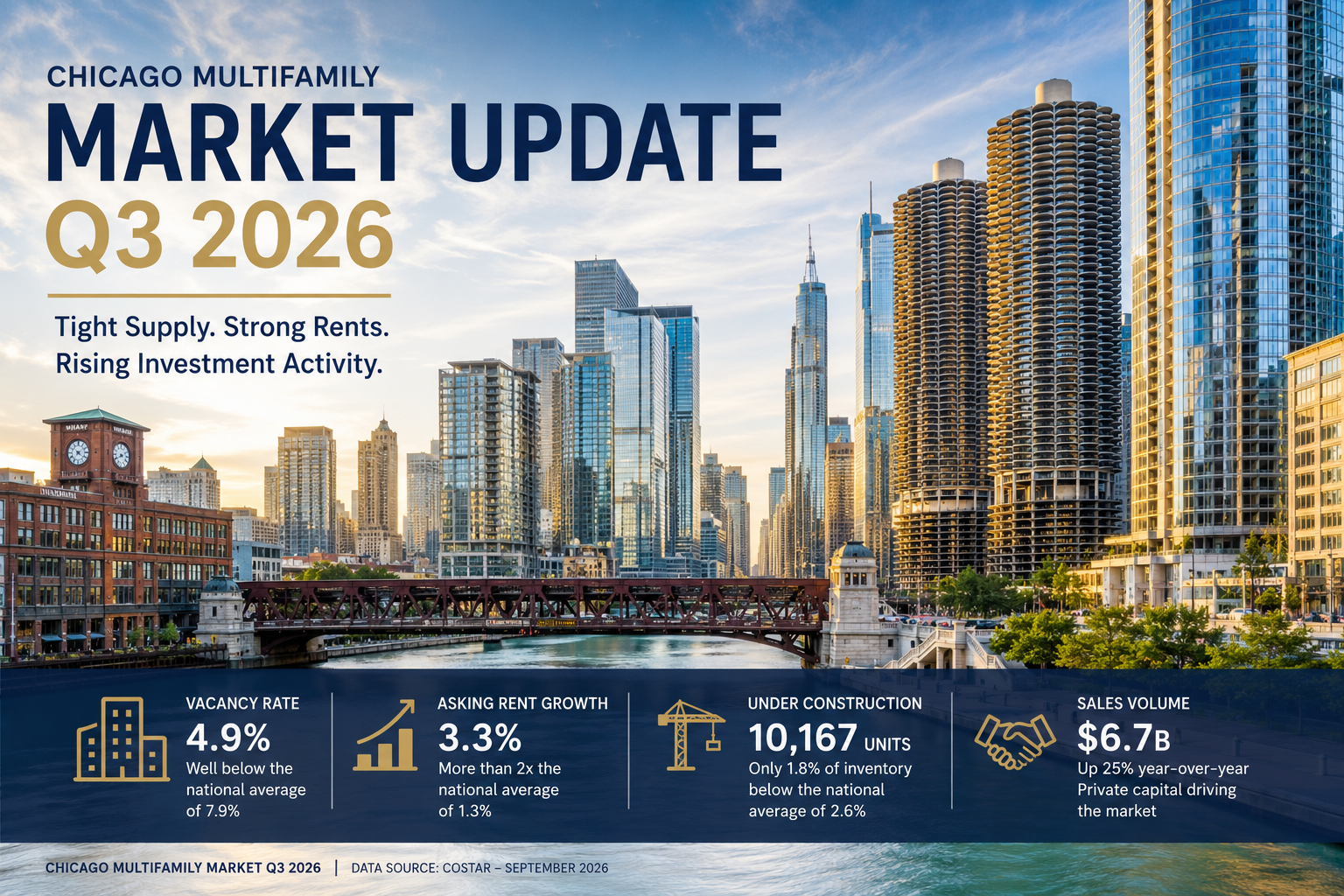
The Chicago multifamily market in Q3 2026 continues to outperform many major U.S. apartment markets.
Vacancy remains below 5%. Rent growth is more than twice the national average. New construction remains constrained. At the same time, multifamily sales volume has increased as private capital returns to the market.
For Chicago-area apartment owners, those trends are constructive—but they do not affect every property equally.
Submarket supply, in-place rents, operating expenses, property condition, and financing can materially change what buyers are willing and able to pay.
Chicago Multifamily Market Q3 2026: Key Metrics
According to CoStar's September 2026 Chicago Multifamily Market Report:
| Market Indicator | Current |
|---|---|
| Vacancy Rate | 4.9% |
| 12-Month Asking Rent Growth | 3.3% |
| Average Asking Rent | $1,975/unit |
| Effective Rent | $1,937/unit |
| 12-Month Absorption | 5,103 units |
| 12-Month Deliveries | 5,790 units |
| Under Construction | 10,167 units |
| Construction / Inventory | 1.8% |
| Trailing 12-Month Sales Volume | $6.7 billion |
Chicago's 4.9% vacancy rate remains well below the 7.9% national average, while annual asking-rent growth of 3.3% compares with approximately 1.3% nationally.
The central theme remains straightforward:
Chicago has enough renter demand to support growth, but not enough new construction to materially weaken existing apartment fundamentals.
Vacancy Remains Near Historic Lows
Chicago multifamily vacancy currently stands at 4.9%, compared with the market's historical average of approximately 6.9%.
Vacancy has edged higher over the past year, but that does not appear to represent broad weakness in stabilized properties.
Much of the increase comes from recently completed apartment communities still moving through initial lease-up. Stabilized vacancy has remained near 4.5%.
That distinction matters to owners of existing buildings.
New supply is entering the market, but recently delivered units are generally being absorbed without creating widespread vacancy pressure across stabilized inventory.
Approximately 5,100 units were absorbed during the past 12 months, exceeding Chicago's long-term annual average of approximately 4,700 units.
Demand has moderated from the unusually strong levels of 2024 and 2025, but it remains healthy by historical standards.
Chicago Rent Growth Continues to Outperform
Average Chicago asking rents are approximately $1,975 to $1,980 per unit, with annual asking-rent growth of 3.3%.
National rent growth is approximately 1.3%.
Chicago has ranked among the five strongest rent-growth markets among the nation's 40 largest multifamily markets since early 2023.
That strength is not evenly distributed.
Urban Chicago Leads Rent Growth
Downtown Chicago and the North Lakefront are currently among the strongest submarkets.
| Submarket | Asking Rent | Annual Growth | Vacancy |
|---|---|---|---|
| Downtown Chicago | $3,169 | 5.0% | 4.6% |
| North Lakefront | $2,249 | 5.0% | 3.6% |
| Aurora | $1,589 | 2.3% | 4.7% |
| Naperville/Lisle | $2,002 | 1.8% | 5.5% |
| North DuPage County | $1,810 | 2.3% | 4.6% |
| Northeast DuPage County | $2,040 | 2.5% | 6.0% |
| Southeast DuPage County | $1,886 | 1.6% | 4.8% |
CoStar's data shows urban effective-rent growth averaging roughly 4%, compared with approximately 2% in the suburbs.
This is one reason property valuation should begin at the submarket level rather than with a Chicago-wide average.
Property Quality Is Affecting Rent Performance
Rent growth also varies by asset quality.
During the past year:
- 4- and 5-Star properties: approximately 4.0% rent growth
- 3-Star properties: approximately 3.0%
- 1- and 2-Star properties: approximately 2.5%
Higher-quality apartments are also capturing a disproportionate share of leasing activity. Approximately 75% of recent absorption occurred in 4- and 5-Star properties.
For owners of older Class B and Class C properties, the takeaway is not necessarily to pursue luxury renovations.
The more useful question is whether targeted improvements can generate a measurable return through:
- Higher achievable rents
- Lower vacancy
- Better tenant retention
- Reduced maintenance
- Stronger buyer perception
A renovation only creates value when the resulting NOI justifies the investment.
Limited Construction Remains Chicago's Biggest Advantage
Chicago currently has approximately 10,167 multifamily units under construction, equal to only 1.8% of existing inventory.
That is below the national level of approximately 2.6%.
More importantly, the pipeline continues to shrink.
CoStar reports that construction starts have fallen approximately 30% during the past year and remain roughly 40% below the 10-year average.
Limited construction remains one of the primary reasons the Chicago multifamily market Q3 2026 continues to outperform many major apartment markets.
Approximately 5,800 units were delivered during the past 12 months.
Projected deliveries are
- 2026: approximately 6,100 units
- 2027: approximately 5,000 units
- 2028: approximately 4,500 units
High construction costs, financing constraints, and regulatory hurdles continue to make new apartment development difficult.
For owners of existing properties, that creates a meaningful competitive advantage.
Replacement cost remains high while future supply is limited.
New Supply Is Concentrated at the Top of the Market
Roughly 70% of apartments currently under construction are 4- and 5-Star units. Luxury communities represented more than 80% of 2025 deliveries.
That means new construction does not compete equally with every existing multifamily property.
A newly built Class A apartment community with extensive amenities may have limited direct competition with a well-located Class B suburban building offering substantially lower rents.
This segmentation can benefit existing owners, particularly where replacement rents are materially above current in-place rents.
Suburban Chicago Has Very Different Supply Conditions
One of the most important points in the current report is the variation between suburban submarkets.
Aurora
Aurora currently has approximately 566 units under construction, equal to roughly 11.1% of existing multifamily inventory.
Vacancy remains approximately 4.7%, and asking rents have increased about 2.3%.
The existing fundamentals remain solid, but owners should watch lease-up activity closely because Aurora's construction pipeline is unusually large relative to its current apartment inventory.
Naperville/Lisle
Naperville/Lisle has approximately 306 units under construction, equal to roughly 1.5% of inventory.
Current asking rents average approximately $2,002 per unit, with 5.5% vacancy.
DuPage County
North DuPage currently has minimal new construction and a vacancy rate of approximately 4.6%.
Northeast DuPage has approximately 473 units underway, while Southeast DuPage has approximately 138 units under construction.
These differences reinforce why a Chicago multifamily property should never be underwritten solely from metro averages.
Chicago Landlords Are Using Few Concessions
Another measure of market strength is concession activity.
Only about 1.5% of Chicago multifamily properties currently offer concessions, compared with roughly 3.5% nationally.
In markets with excessive supply, landlords often compete through free rent, reduced deposits, or other incentives.
Chicago's low concession rate indicates that most landlords still have sufficient pricing power to maintain rents without aggressively discounting occupancy.
Chicago Multifamily Sales Volume Reaches $6.7 Billion
The capital markets are also improving.
Chicago multifamily sales volume reached approximately $6.7 billion during the trailing 12 months, representing a roughly 25% year-over-year increase.
National sales volume increased approximately 5% during the same period.
That is important for owners considering a disposition.
Property values require more than strong operating fundamentals. Sellers also need active buyers with equity, financing, and confidence in future performance.
Chicago's buyer pool is becoming more active.
Private Investors Are Driving the Market
Private buyers historically represented approximately 60% of Chicago apartment transactions.
During the past year, their share increased to more than 70%, while institutional participation declined to approximately 20%.
This is particularly relevant to privately owned apartment properties.
Most Chicago and suburban multifamily buildings do not compete directly with $100 million institutional transactions. Their likely buyer pool consists of private investors, family offices, syndicators, and 1031 exchange buyers.
An expanding private-capital buyer pool can improve:
- Market liquidity
- Competitive bidding
- Price discovery
- Transaction certainty
Multifamily Values Are Rising Without Major Cap-Rate Compression
Perhaps the most important capital-markets trend is that the average price per unit increased approximately 10% year over year, while cap rates remained relatively stable.
That suggests property income is doing more of the work.
For owners, this is an important distinction.
Value does not require cap rates to return to 2021 levels.
If NOI increases while cap rates remain stable, property value can still rise.
Chicago Multifamily Cap Rates by Property Quality
CoStar's current modeled market cap rates are approximately
| Property Quality | Market Cap Rate |
|---|---|
| 4 & 5 Star | 5.9% |
| 3-Star | 6.6% |
| 1 & 2 Star | 7.5% |
These figures are useful benchmarks, but they are not property-specific valuation conclusions.
Actual pricing depends on rent levels, operating expenses, location, condition, taxes, deferred maintenance, unit mix, and available financing.
What Should Chicago Multifamily Owners Do Now?
The Q3 2026 market data supports several practical conclusions.
Review Rent Position
Compare every unit against current competitive rents.
The relevant question is not simply whether rents can increase. It is whether the increase is sustainable after considering turnover, condition, and competing inventory.
Protect NOI.
In a relatively stable cap-rate environment, NOI is one of the most direct drivers of value.
Review:
- Property taxes
- Insurance
- Utilities
- Repairs and maintenance
- Management
- Collections
- Vacancy
- Loss-to-lease
Prepare Financial Records Before a Sale
Buyers and lenders need credible historical information.
Owners considering a sale should have a current rent roll, trailing operating statement, tax bills, insurance costs, utility history, and major capital improvements organized before marketing begins.
Evaluate Value Using Current Data
Owners relying on valuations completed during 2023 or 2024 may be working from outdated assumptions.
Rents, transaction liquidity, and buyer activity have changed materially.
A current valuation can establish whether the best strategy is to sell, refinance, hold, or make operational improvements before going to market.
Chicago Multifamily Outlook for Late 2026
The Chicago multifamily market in Q3 2026 remains supported by an unusually favorable supply-demand balance.
Vacancy remains below 5%.
Rent growth is running well above the national average.
Construction activity continues to decline.
Concessions remain limited.
Investment sales volume is rising.
Private capital is increasingly active.
There are also risks.
Population growth has moderated, financing remains relatively expensive, and Cook County property-tax uncertainty continues to affect underwriting.
The market should therefore be viewed as constructive rather than indiscriminately bullish.
CoStar expects apartment deliveries to remain below historical norms through 2028. If renter demand remains reasonably stable, Chicago's limited construction pipeline should continue to support apartment occupancy and rent growth.
For property owners, the opportunity is increasingly asset-specific.
Determine Your Property's Current Market Position
Market reports establish direction. They do not establish the value of an individual apartment building.
For owners, the Chicago multifamily market Q3 2026 remains constructive, but value is increasingly determined by individual property performance and submarket conditions.
A current Broker Opinion of Value should reconcile:
- In-place rents
- Market rents
- Trailing operating performance
- Normalized expenses
- Property taxes
- Comparable multifamily sales
- Current cap rates
- Buyer financing
- Property condition
- Submarket supply and demand
For Chicago-area multifamily owners considering a sale, refinance, estate-planning decision, or portfolio strategy, a current property-level analysis can establish probable market pricing and identify opportunities to strengthen value before going to market.
https://creconsult.net/chicago-multifamily-market-q3-2026/?fsp_sid=2925
Wednesday, September 2, 2026
Now offered at $895,000, this ±4,000 SF fully occupied retail condominium presents a compelling value-add opportunity in Chicago’s Albany Park neighborhood.
Highlights:
• 6 fully occupied storefront suites
• Five of six suites currently month-to-month
• Near-term rent and lease restructuring potential
• Owner-user flexibility
• High-visibility Montrose Avenue location with CTA access
The current lease structure gives a purchaser flexibility to improve rents, recoveries and overall NOI without waiting on long-term lease expirations.
Property details and Offering Memorandum:
https://creconsult.net/property/3217-3229-west-montrose-avenue-chicago-7-unit-retail/
Randolph Taylor, MBA, CCIM, MiCP
Vice President | Commercial Real Estate Investment Sales
eXp Commercial - Chicago
630-474-6441 | rtaylor@creconsult.net
#CommercialRealEstate #ChicagoRealEstate #RetailForSale #ValueAdd
-
Just Listed: Golf Sumac Medical Offices | Des Plaines IL Price: $3,900,000 SF: 35,245 Stories: 3 Occupancy: 82.3% Cap Rate: 9.63% * Stabiliz...
-
The Chicago multifamily market in Q3 2026 continues to outperform many major U.S. apartment markets. Vacancy remains below 5%. Rent growth ...
-
The Chicago multifamily financing 2026 environment is improving, but apartment owners should distinguish between more available capital an...


