Showing posts with label multifamily investment. Show all posts

Friday, May 15, 2026

4 Key Differences: Deferred Sales Trust vs Delaware Statutory Trust


Comparing a Deferred Sales Trust vs Delaware Statutory Trust is one of the most critical steps for multifamily owners who want to sell but are paralyzed by the looming threat of capital gains taxes.


As a multifamily investment sales broker, I frequently speak with owners who are exhausted by property management. They want to sell, but they refuse to hand 30% to 40% of their equity over to the IRS, and they certainly do not want to buy another apartment building to manage.


In our recent guide on crafting a successful Chicago multifamily disposition strategy, we highlighted absolute triple-net (NNN) leases and the Delaware Statutory Trust (DST) as powerful 1031 exchange vehicles to solve this exact problem.


However, as you research these exit options, you will almost certainly run into a confusing roadblock: there is another DST out there.


Promoters heavily market the Deferred Sales Trust as a 1031 alternative, promising high yields and stock market flexibility. Because they share the exact same acronym, sellers often mistake them for the same thing. They are not.


When conducting a true comparison of a Deferred Sales Trust vs Delaware Statutory Trust, you must understand that they rely on completely different tax codes, hold entirely different assets, and carry drastically different risks. By understanding these options, you can confidently list and sell your property knowing your wealth is protected.


Here are four key facts to tell the two DSTs apart.


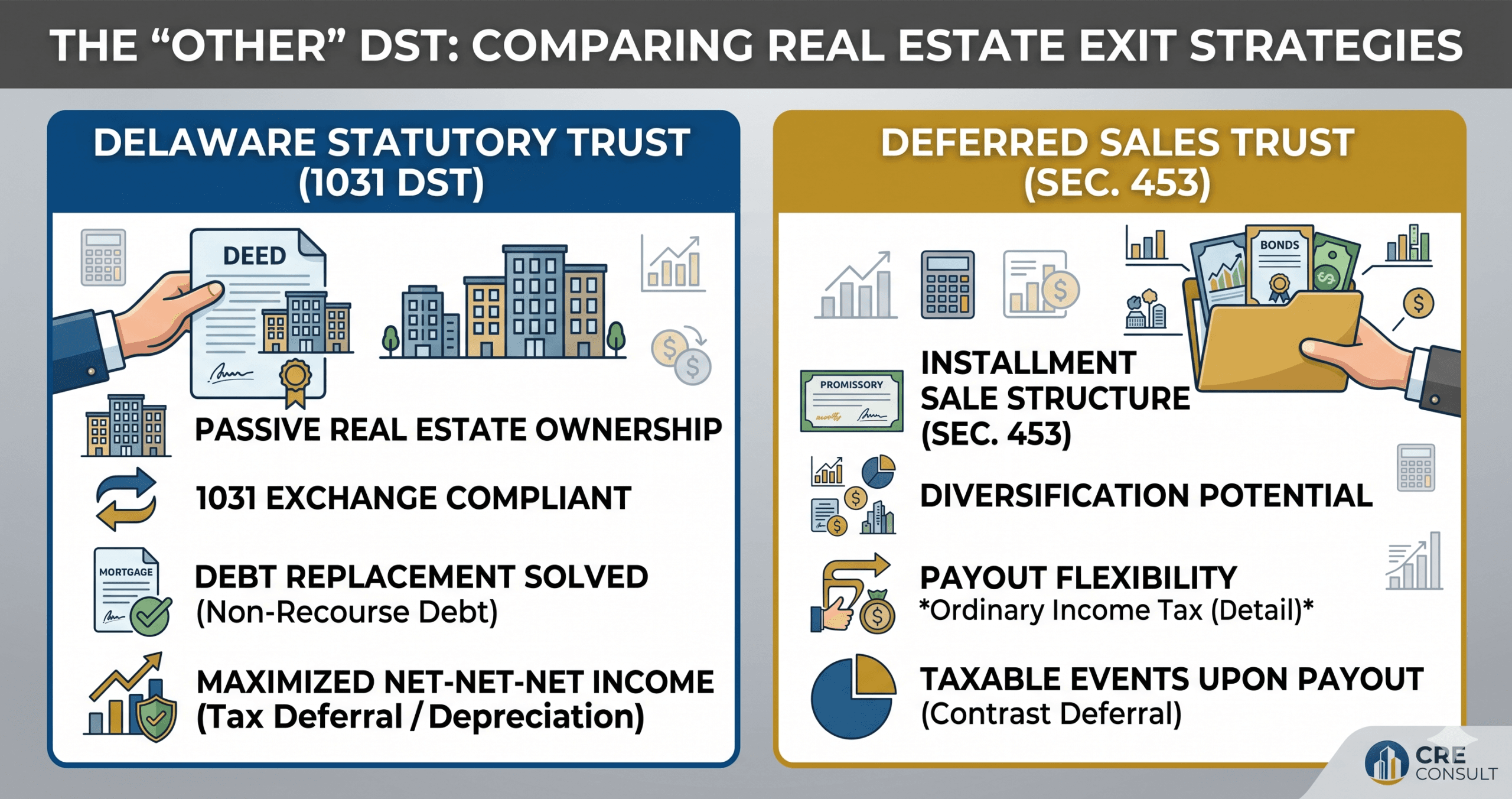
The foundational difference in a Deferred Sales Trust vs Delaware Statutory Trust setup lies in how they interact with the IRS tax code.


The Delaware Statutory Trust (The Real Estate Route) This structure operates under the standard 1031 exchange. When we sell your multifamily property, you reinvest your proceeds into a fractional share of institutional-grade, physical real estate. This could be a massive data center, a medical facility, or a 300-unit apartment complex. You remain invested in tangible real estate and preserve your wealth without the headaches of day-to-day management.


The Deferred Sales Trust (The Stock Market Route) This structure relies on the installment sale rules found in IRC Section 453 (External Link). Instead of buying new real estate, you sell your property to a specialized trust in exchange for a promissory note. The trust then sells the property to the final buyer for cash and invests that cash into traditional financial markets (stocks, bonds, and mutual funds) to fund your monthly note payments.


2. The Yield Illusion: Gross Payout vs. Net After-Tax Income


In the battle of yield between a Deferred Sales Trust vs Delaware Statutory Trust, many commercial investors are drawn to the installment option because promoters might promise a 6% to 8% payout. This looks attractive compared to the 4.5% to 5.5% cash-on-cash returns typical of today's real estate funds.


However, savvy sellers know you must look at the net-net-net after-tax return.


  • The Ordinary Income Trap: Every dollar paid out from a Deferred Sales Trust promissory note is taxed as ordinary income. If you sit in a higher federal tax bracket, up to 40% of your Deferred Sales Trust income will be instantly eaten by taxes. A 7.5% gross yield quickly shrinks to a 4.5% net yield.


  • The Real Estate Tax Shield: By contrast, the income from a Delaware Statutory Trust is heavily sheltered by real estate depreciation. Because you own physical property, you receive a "phantom" expense deduction. Often, 50% to 70% of your DST yield is completely shielded from current-year income taxes.


The reality is that the actual take-home cash in your pocket is often nearly identical between the two, but the Deferred Sales Trust requires you to take on stock market volatility to get it.


3. The Fully Depreciated Property and the "Debt Trap"


If you have owned your apartment building for decades, you have likely fully depreciated the asset, meaning your cost basis is zero. This scenario exposes a massive hidden risk. A major deciding factor between a Deferred Sales Trust vs Delaware Statutory Trust is how they handle your existing mortgage.


To completely defer your taxes in a real estate transaction, the IRS requires you to replace whatever debt you pay off at closing.


  • Delaware Statutory Trust Advantage: These funds come with pre-packaged, non-recourse debt baked right into the structure. If you need to replace $1 million in debt, you simply buy into a leveraged fund, effortlessly satisfying the IRS requirement without ever signing a personal loan document.


  • Deferred Sales Trust Risk: A Deferred Sales Trust does not replace debt. The mortgage is simply paid off at closing. However, if your mortgage balance is higher than your depreciated cost basis, the IRS treats the difference as a "constructive payment." This triggers a massive, immediate tax penalty. A Deferred Sales Trust cannot protect you from this "debt over basis" trap.


4. Estate Planning: Generational Wealth Transfer


How do these structures perform when it is time to pass wealth down to your family? For legacy planning, a Deferred Sales Trust vs Delaware Statutory Trust offers vastly different outcomes.


If you hold a Delaware Statutory Trust until you pass away, your heirs inherit the physical real estate with a "step-up in basis." This incredible IRS provision effectively wipes out decades of deferred capital gains and depreciation recapture taxes, allowing your family to inherit the full value of the asset tax-free.


If you pass away while holding a Deferred Sales Trust, your heirs simply inherit the remaining balance of the promissory note. This is treated as "Income in Respect of a Decedent" (IRD). There is no step-up in basis, meaning your heirs inherit your tax liability along with the note.


Evaluating a Deferred Sales Trust vs Delaware Statutory Trust to Facilitate Your Sale


At the end of the day, my job as a multifamily investment sales broker is not to sell you trust products. My job is to help you successfully sell your property at the absolute highest market value and guide you toward the right exit strategy so you can actually keep your profits.


Ultimately, choosing between a Deferred Sales Trust vs Delaware Statutory Trust comes down to your ultimate financial goals and risk tolerance. If capital gains tax concerns are the only thing keeping you from listing your property and moving on to your next chapter, you have powerful options available to you.


By bringing in the right 1031 accommodators and financial planners, we can structure a highly profitable sale that transitions you out of the landlord business and into stable, passive retirement income.


Are taxes holding you back from selling? Let's discuss your options. Contact Randolph Taylor and the team at CRE Consult today to explore a disposition strategy tailored to your property.


https://creconsult.net/deferred-sales-trust-vs-delaware-statutory-trust/?fsp_sid=2508

Wednesday, January 29, 2025

Chicago Multi-Family Market: Trends and 2025 Projections


Chicago Multi-Family Market: Trends and 2025 Projections


Chicago’s multi-family market is experiencing significant growth and challenges in 2025. From rising asking rents to shifting vacancy rates, the city’s housing market reflects a complex landscape. Understanding these trends is crucial for investors navigating Chicago’s multi-family real estate opportunities.


Rising Rents and Shifting Vacancy Rates in the Chicago Multi-Family Market


Asking Rents on the Rise


As of November 2024, the average asking rent in Chicago’s multi-family market reached $1,885, an 0.6% increase from the previous month. This represents the eighth consecutive month of rent increases, reflecting strong demand across the city.


Vacancy Rates at a High


Despite climbing rents, vacancy rates in Chicago’s multi-family housing market stand at 5.5%, the highest since 2021.


  • Projected Vacancy Rate: Expected to drop slightly to 5.3% by the end of 2024, indicating a potential stabilization.

  • Investor Insight: Rising vacancy rates could signal an oversupply issue in certain submarkets, requiring careful analysis.


Economic Context


A housing analyst stated:


“Rising rents highlight demand growth, but wages and employment must keep pace to sustain affordability.”


Chicago’s employment rate declined by 0.1%, contrasting with national growth of 0.2%, creating challenges for the local rental market.


Submarket Insights: Gold Coast’s Role in the Multi-Family Market


Current Inventory and New Units


The Gold Coast submarket remains a focal point in Chicago’s multi-family market:


  • Existing Units: 44,562

  • Future Supply: 9,347 new units projected for delivery between 2025 and 2026.


Class A vs. Class BC Units


Class A properties command higher rents and maintain lower vacancy rates, while Class BC units face higher vacancy challenges.


  • Vacancy Gap: Up to 5.9% between Class A and Class BC units.

  • Investor Opportunity: Focusing on Class BC properties in strategic submarkets could yield higher returns with targeted improvements.


Investment Metrics in Chicago’s Multi-Family Market


Transaction Volumes and Cap Rates


Chicago’s multi-family market is projected to generate $148 million in transactions in 2025. Notable deals include the $144 million sale of 1326 S Michigan Ave, reflecting strong investor interest.


  • 12-Month Rolling Cap Rate: 6.2%, providing a benchmark for returns on investment properties.


“Understanding cap rates is vital for identifying profitable investments,” noted a real estate expert.


Economic and Demographic Trends Shaping Chicago’s Multi-Family Market


Income and Employment Challenges


While Chicago’s median household income grew by 0.6%, it lags behind the 3% annual increase in asking rents projected through 2026. This disparity highlights affordability concerns for residents.


  • Employment Decline: Chicago’s employment dropped by 0.1%, contrasting with national gains.


Future Projections


With 9,347 new units expected by 2026, the balance between supply and demand will be critical. Rising rents, coupled with increasing vacancy rates, suggest potential oversupply issues in certain areas.


Key Metrics for Chicago’s Multi-Family Market


MetricValue
Average Asking Rent$1,885
Current Vacancy Rate5.5%
Projected Vacancy Rate (2024)5.3%
Gold Coast Inventory44,562 units
New Units (2025-2026)9,347 units
12-Month Rolling Cap Rate6.2%


Conclusion: Navigating Chicago’s Multi-Family Market in 2025


Chicago’s multi-family market reflects a mix of opportunities and challenges. Rising rents, higher vacancy rates, and significant new inventory require careful navigation. Investors must:


  1. Monitor submarket trends, particularly in the Gold Coast and other high-growth areas.

  2. Analyze cap rates to identify profitable opportunities.

  3. Align investment strategies with shifting economic and demographic dynamics.


By staying informed and adapting to market trends, investors can position themselves for success in Chicago’s evolving multi-family market.


https://www.creconsult.net/market-trends/chicago-multi-family-market-trends/?fsp_sid=504

Tuesday, January 28, 2025

Chicago Multifamily Investments: 2025 Insights and Strategies


Introduction: Why Chicago Multifamily Investments Are Promising for 2025


The Chicago multifamily investments landscape is shifting, presenting property owners with new challenges and opportunities. The 2025 National Multifamily Investment Forecast by Marcus & Millichap offers critical insights for navigating this dynamic sector. With inflation easing, stable interest rates, and rising household formations, Chicago investors are well-positioned to capitalize on these favorable conditions.


Promising Economic Trends for Multifamily Investors


1. Stable Interest Rates: A Catalyst for Growth


Inflation reduction has created a stable interest rate environment, benefiting both investors and renters.


  • Lower borrowing costs: Investors can secure loans at favorable terms.

  • Increased investment activity: Accessible financing encourages market participation.

  • Enhanced property values: Demand for multifamily units rises in a stable economic climate.


As Marcus & Millichap stated:


"Stability in interest rates can open avenues for growth in multifamily investments."


2. Household Formation Fuels Demand


National job growth of 2.1% in 2025 is expected to drive household formation. More people moving out and forming new households means increased demand for rental units.


  • Projected Rent Growth: Average effective rent is forecasted to reach $1,884 nationwide.

  • Opportunities for Chicago Owners: Rising demand presents a chance to boost rental revenue.


3. Investor Readiness and Strategy


With favorable lending conditions and reduced inflation, investors are prepared to act.


  • Focus Areas: Class B and Class C assets in secondary markets often yield better returns and face less competition.

  • Potential Risks: Federal policy changes post-election may impact the market. Investors must stay adaptable.


Chicago’s Multifamily Market in Context


Key Market Dynamics


Chicago benefits from national multifamily trends but faces unique local challenges.


  • Regulations: Local policies can affect rental market profitability.

  • Population Movements: Understanding shifts within the city is essential for targeted investments.


Comparing Regional Trends


Sun Belt markets like Miami-Dade and Dallas-Fort Worth lead in rent growth and occupancy rates. Meanwhile, Chicago must adapt to its slower but steady growth trajectory.


Regional Insights: Opportunities in the Multifamily Sector


Sun Belt Markets Thrive


Cities like Miami-Dade and Dallas-Fort Worth are experiencing strong demand due to robust job markets and population growth.


  • Miami-Dade: Projected rent growth remains high.

  • Dallas-Fort Worth: Strong employment opportunities support occupancy rates.


Challenges in Coastal Markets


San Diego and Los Angeles face rising insurance costs and inflation, complicating profitability.


Chicago Multifamily Investments: Localized Strategies


1. Focus on Class B and C Assets


Class B and Class C properties attract renters priced out of Class A markets and offer opportunities for value-add investments.


2. Adapt to Supply Constraints


Decreased permitting activity may stabilize long-term supply, keeping occupancy rates high even as demand grows.


Market Insights from the National Multifamily Index (NMI)


The NMI highlights market performance across regions, emphasizing Chicago’s mixed opportunities.


Key Metrics for 2025


MetricValue
National Job Growth2.1%
Projected Average Rent$1,884
Interest Rate StabilityFavorable
Notable RegionsSun Belt markets


Conclusion: Strategic Planning for Chicago Multifamily Investments


The 2025 outlook for Chicago multifamily investments is optimistic, with stable interest rates, rising household formations, and increased demand for rental units. However, investors must remain vigilant, adapting to potential policy changes and local market dynamics.


Key Takeaways for Chicago Investors:


  1. Monitor Submarkets: Target high-growth areas with strong rental demand.

  2. Invest in Class B and C Assets: These provide solid returns and face less competition.

  3. Stay Informed: Leverage insights from reports like the National Multifamily Index to navigate market complexities.


By focusing on these strategies, investors can position themselves for success in Chicago’s evolving real estate landscape.


https://www.creconsult.net/market-trends/navigating-the-2025-multifamily-investment-landscape-insights-for-chicago-owners/?fsp_sid=488

Thursday, January 16, 2025

Elevate Your Multifamily Property Value: Strategic Upgrades That Matter

Elevate Your Multifamily Property Value: Strategic Upgrades That Matter
Modernizing your multifamily property isn’t just good for tenants; it's a smart investment strategy. Learn how to enhance property value through strategic upgrades and request a free valuation analysis today!

CALL FOR OFFERS: Regus Anchored Office Asset Written submissions for this corporate office asset are due next Friday, May 29th at 5:00 PM CS...