Showing posts with label 1031 Exchange. Show all posts

Friday, May 15, 2026

4 Key Differences: Deferred Sales Trust vs Delaware Statutory Trust


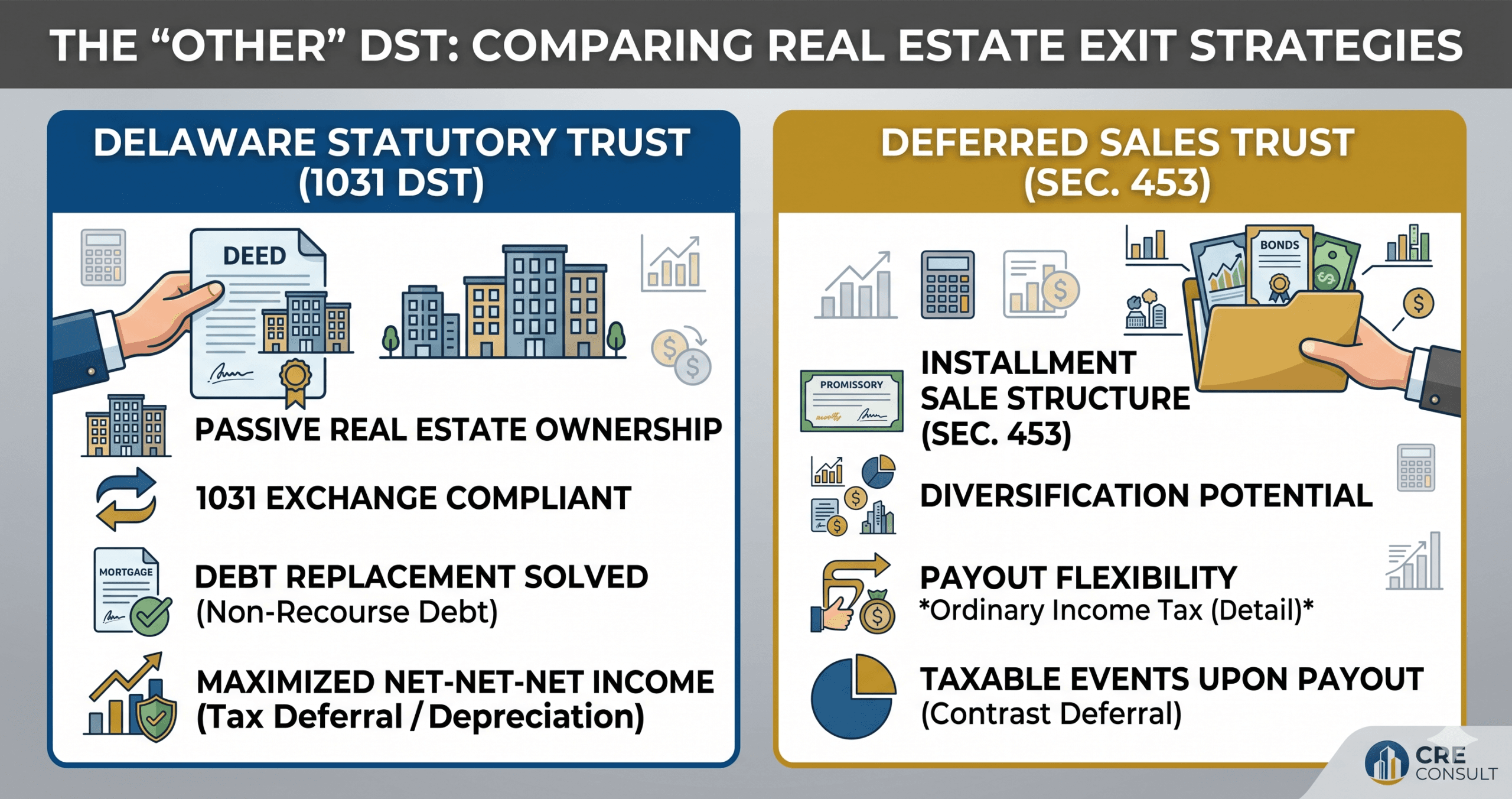
Comparing a Deferred Sales Trust vs Delaware Statutory Trust is one of the most critical steps for multifamily owners who want to sell but are paralyzed by the looming threat of capital gains taxes.


As a multifamily investment sales broker, I frequently speak with owners who are exhausted by property management. They want to sell, but they refuse to hand 30% to 40% of their equity over to the IRS, and they certainly do not want to buy another apartment building to manage.


In our recent guide on crafting a successful Chicago multifamily disposition strategy, we highlighted absolute triple-net (NNN) leases and the Delaware Statutory Trust (DST) as powerful 1031 exchange vehicles to solve this exact problem.


However, as you research these exit options, you will almost certainly run into a confusing roadblock: there is another DST out there.


Promoters heavily market the Deferred Sales Trust as a 1031 alternative, promising high yields and stock market flexibility. Because they share the exact same acronym, sellers often mistake them for the same thing. They are not.


When conducting a true comparison of a Deferred Sales Trust vs Delaware Statutory Trust, you must understand that they rely on completely different tax codes, hold entirely different assets, and carry drastically different risks. By understanding these options, you can confidently list and sell your property knowing your wealth is protected.


Here are four key facts to tell the two DSTs apart.


The foundational difference in a Deferred Sales Trust vs Delaware Statutory Trust setup lies in how they interact with the IRS tax code.


The Delaware Statutory Trust (The Real Estate Route) This structure operates under the standard 1031 exchange. When we sell your multifamily property, you reinvest your proceeds into a fractional share of institutional-grade, physical real estate. This could be a massive data center, a medical facility, or a 300-unit apartment complex. You remain invested in tangible real estate and preserve your wealth without the headaches of day-to-day management.


The Deferred Sales Trust (The Stock Market Route) This structure relies on the installment sale rules found in IRC Section 453 (External Link). Instead of buying new real estate, you sell your property to a specialized trust in exchange for a promissory note. The trust then sells the property to the final buyer for cash and invests that cash into traditional financial markets (stocks, bonds, and mutual funds) to fund your monthly note payments.


2. The Yield Illusion: Gross Payout vs. Net After-Tax Income


In the battle of yield between a Deferred Sales Trust vs Delaware Statutory Trust, many commercial investors are drawn to the installment option because promoters might promise a 6% to 8% payout. This looks attractive compared to the 4.5% to 5.5% cash-on-cash returns typical of today's real estate funds.


However, savvy sellers know you must look at the net-net-net after-tax return.


  • The Ordinary Income Trap: Every dollar paid out from a Deferred Sales Trust promissory note is taxed as ordinary income. If you sit in a higher federal tax bracket, up to 40% of your Deferred Sales Trust income will be instantly eaten by taxes. A 7.5% gross yield quickly shrinks to a 4.5% net yield.


  • The Real Estate Tax Shield: By contrast, the income from a Delaware Statutory Trust is heavily sheltered by real estate depreciation. Because you own physical property, you receive a "phantom" expense deduction. Often, 50% to 70% of your DST yield is completely shielded from current-year income taxes.


The reality is that the actual take-home cash in your pocket is often nearly identical between the two, but the Deferred Sales Trust requires you to take on stock market volatility to get it.


3. The Fully Depreciated Property and the "Debt Trap"


If you have owned your apartment building for decades, you have likely fully depreciated the asset, meaning your cost basis is zero. This scenario exposes a massive hidden risk. A major deciding factor between a Deferred Sales Trust vs Delaware Statutory Trust is how they handle your existing mortgage.


To completely defer your taxes in a real estate transaction, the IRS requires you to replace whatever debt you pay off at closing.


  • Delaware Statutory Trust Advantage: These funds come with pre-packaged, non-recourse debt baked right into the structure. If you need to replace $1 million in debt, you simply buy into a leveraged fund, effortlessly satisfying the IRS requirement without ever signing a personal loan document.


  • Deferred Sales Trust Risk: A Deferred Sales Trust does not replace debt. The mortgage is simply paid off at closing. However, if your mortgage balance is higher than your depreciated cost basis, the IRS treats the difference as a "constructive payment." This triggers a massive, immediate tax penalty. A Deferred Sales Trust cannot protect you from this "debt over basis" trap.


4. Estate Planning: Generational Wealth Transfer


How do these structures perform when it is time to pass wealth down to your family? For legacy planning, a Deferred Sales Trust vs Delaware Statutory Trust offers vastly different outcomes.


If you hold a Delaware Statutory Trust until you pass away, your heirs inherit the physical real estate with a "step-up in basis." This incredible IRS provision effectively wipes out decades of deferred capital gains and depreciation recapture taxes, allowing your family to inherit the full value of the asset tax-free.


If you pass away while holding a Deferred Sales Trust, your heirs simply inherit the remaining balance of the promissory note. This is treated as "Income in Respect of a Decedent" (IRD). There is no step-up in basis, meaning your heirs inherit your tax liability along with the note.


Evaluating a Deferred Sales Trust vs Delaware Statutory Trust to Facilitate Your Sale


At the end of the day, my job as a multifamily investment sales broker is not to sell you trust products. My job is to help you successfully sell your property at the absolute highest market value and guide you toward the right exit strategy so you can actually keep your profits.


Ultimately, choosing between a Deferred Sales Trust vs Delaware Statutory Trust comes down to your ultimate financial goals and risk tolerance. If capital gains tax concerns are the only thing keeping you from listing your property and moving on to your next chapter, you have powerful options available to you.


By bringing in the right 1031 accommodators and financial planners, we can structure a highly profitable sale that transitions you out of the landlord business and into stable, passive retirement income.


Are taxes holding you back from selling? Let's discuss your options. Contact Randolph Taylor and the team at CRE Consult today to explore a disposition strategy tailored to your property.


https://creconsult.net/deferred-sales-trust-vs-delaware-statutory-trust/?fsp_sid=2508

Friday, February 13, 2026

Chicago Multifamily Outlook: Rents, Caps, 1031 Plans


The Chicago multifamily market enters 2026 defined by a tightening supply-demand gap, as new deliveries fall to historic lows. While national rent growth has cooled, Chicago apartment rents remain resilient in core submarkets, supporting stable apartment asset values despite broader economic volatility. This analysis examines the current cap rate outlook for Chicago, which remains elevated above the national average, and provides a framework for a 1031 exchange strategy tailored to a higher-for-longer interest rate environment.


Executive snapshot: Where national trends meet Chicago


National rent growth cooled, with pockets of strength


After mid-2025, U.S. rent growth slowed, but select Sun Belt hubs rebounded. National rent growth in Q4 2025 was +2.1% year over year, while top Sun Belt markets posted +4.0% to +6.0% in 2025. This gap matters because national rent growth outperformed Chicago in 2025, shaping broader Multifamily investment trends 2026 toward cautious, income-focused deals.


Chicago multifamily market: softer leasing and rent drift


In the Chicago multifamily market, leasing velocity was softer and several submarkets saw modest negative rent drift. Chicago apartment rents were -1.2% year over year in Q4 2025, alongside a 6.2% vacancy rate. Local vacancy and concessions are the primary drivers of rent softness, especially where new deliveries compete for the same renter pool.


Seasonality can amplify short-term swings: student leasing cycles, corporate relocations, and the timing of new deliveries can temporarily lift or pressure occupancy and effective rents.


John Reynolds, Senior Director at Lakeshore Advisors: "Chicago’s rent path is uneven—owners with stabilized, well-located assets still see healthy demand."


Maria Lopez, Multifamily Strategist, Windy City Capital: "Underwriting discipline matters more than ever; the numbers are nuanced by submarket and product class."


Immediate investor takeaway


  • Reprice underwriting assumptions for operating income to reflect concessions and slower absorption.


  • Stress-test exit cap rates and valuation sensitivity, given uneven rent momentum.


  • Align with Multifamily investment trends 2026: cautious allocation toward stabilized assets with durable demand drivers.


Data snapshot: National vs. Chicago metrics (table)


This single table gives CFOs, asset managers, and advisors a quick scan of market exposure. It highlights how negative rent movement in Chicago can pressure near-term NOI and, by extension, Apartment asset values. It also frames the Cap rate outlook Chicago, where Chicago’s 2025 cap rate runs about 0.7% higher than the national average, and notes softer deal flow tied to reduced 1031 activity.


Metric (Q4 2025 / 2025)


National


Chicago Metro


YoY / YTD Note


Rent growth (YoY, Q4 2025)


+2.1%


-1.2%


Chicago rent decline can depress NOI near term


Average multifamily cap rate (2025)


4.9%


5.6%


~0.7% cap rate premium vs. national


Estimated apartment asset values (2025 YTD)


-4.5%


Value pressure aligns with weaker rent trend


1031 exchange transaction volume (2025 YoY)


-10%


-10%


Reduced activity suggests more hold decisions


Common 1031 timelines


45-day identification; 180-day exchange completion (1031 exchange strategy timing risk)


Ethan Patel, Portfolio Manager, Midwest Capital Partners: “Tables don't replace fieldwork, but they highlight where to dig deeper—Chicago's cap rate premium is real.”


Olivia Grant, Tax Counsel, Grant & Meyers LLP: “1031 exchange rules are rigid; timing and documentation are the hidden risks for every owner.”


What softer Chicago apartment rents mean for landlords


Revenue pressure and Apartment asset values


Softer Chicago apartment rents create immediate revenue pressure: negative rent drift and longer marketing windows can reduce year-one NOI for value-add plans. In 2025, typical days on market rose +12 days YoY, increasing vacancy loss and carrying costs. Because concessions and vacancy trends materially affect effective rent, even modest giveaways can ripple into underwriting and Apartment asset values across the Chicago multifamily market.


Chicago sample (2025)


Observed impact


Average concession impact on effective rents


1.5% to 3.0%


Marketing time


+12 days YoY


Renewal lift strategies


~8% lower turnover (hedged portfolios)


Leasing tactics: protect occupancy, watch effective rent


Owners are using concessions and flexible lease terms to stabilize occupancy, but these tools compress effective rents if not tightly managed. Location and product quality remain the primary near-term drivers, so pricing power is strongest where demand is deepest.


Samantha Cole, COO, Harborpoint Property Management: "Small operational fixes—faster turnovers, smarter renewals—can offset a surprising amount of rent pressure."


Operational levers and submarket variance


  • Turnover work orders: shorten downtime with faster make-readies and vendor scheduling.


  • Utility controls: reduce waste and align RUBS/submetering where feasible.


  • Targeted amenity spend: prioritize high-ROI items (package rooms, access control) over broad upgrades.


  • Micromarketing: neighborhood-specific ads and employer outreach for lease-up.


Downtown, the lakefront, and select neighborhood nodes are holding up better than peripheral suburbs. One North Side landlord cut concessions from two weeks to one by focusing on renewals and service response times, protecting cash flow while keeping occupancy steady.


Cap rate outlook Chicago and asset-value implications


Cap rate outlook Chicago and asset-value implications


The Cap rate outlook Chicago remains the key swing factor for pricing in 2026. Cap rates have re-priced higher for smaller, older, or higher-variance assets, while institutional core properties in top submarkets have been more insulated. Research suggests cap-rate widening is the principal near-term valuation risk for Chicago multifamily assets, and well-underwritten, stabilized properties should see less erosion in value than transitional or niche product.


Chicago’s average multifamily cap rate in 2025 is about 5.6% versus a 4.9% national average. That wider spread can influence portfolio rebalancing: some allocators may demand higher yields to stay in Chicago, while others may view the spread as compensation for market-specific risk and a reason to selectively add exposure.


Apartment asset values: why small cap moves matter


Rising cap rates reduce Apartment asset values even when operations are stable. As an illustrative aside, a stabilized property with $600,000 NOI values at $600,000 / 0.050 = $12,000,000 at a 5.0% cap, but at 5.5% it values at $600,000 / 0.055 = $10,909,091 (about -9.1%). Every 25 bps move can change valuation materially.


Multifamily investment trends 2026: underwriting sets the pace


  • Debt pricing and tighter lender DSCR tests can slow value discovery and cap aggressive bids.


  • Stabilized cash flow supports tighter caps than transitional business plans.


Daniel Keane, Head of Transactions, Prairie Real Estate Group: “Cap-rate moves are the simplest technical factor that convert income misses into capital losses—prepare for modest spread normalization in 2026.”


Strategic moves: Acquisitions, dispositions, and 1031 exchange strategy


In the Chicago multifamily market, opportunistic sellers may face thinner buyer pools as 1031 activity cools (estimated -10% YoY in 2025). That makes a disciplined 1031 exchange strategy more important, especially when buyer demand tightens and pricing becomes less forgiving. With Chicago cap rates running about ~70 basis points above national levels (2025), owners should underwrite exits conservatively and avoid assuming quick cap-rate compression.


Acquisitions: focus on durable cash flow


For Multifamily investment trends 2026, buyers are prioritizing cash flow resilience: stable submarkets, transit and job access, and tenant-demographic tailwinds. When exchange volumes decline, relationship-based sourcing matters more because the best deals trade quietly and timelines are shorter.


Dispositions and exchange logistics


Owners weighing a sale should model two paths: taxable sale versus exchange. If cap-rate compression looks unlikely, tax deferral may be the stronger outcome—but only with strict timing discipline and clean execution.


  • 45-day identification rule: identify replacement properties within 45 days of closing the sale.


  • 180-day completion rule: close the replacement purchase within 180 days.


  • Qualified intermediary required: sale proceeds cannot be received directly by the investor.


Creative structures can help. A reverse 1031 may fit when buying first is necessary, but it raises capital and diligence demands in a slower market.


Olivia Grant, Tax Counsel, Grant & Meyers LLP: "In a slower 1031 market, liquidity planning and early pairing become competitive advantages."


Mark Fisher, Principal, Riverbend Investments: "Some owners find a reverse 1031 attractive when buying first makes sense—just plan for upfront capital needs."


Forward-looking risks, scenarios, and tactical checklist


In the Chicago multifamily market, forward risk centers on rate volatility (Fed guidance and regional lending spreads), uneven job growth by submarket, a new supply pipeline of roughly 6,000 to 8,000 metro deliveries in 2025–2026 (illustrative), and shifting commuter patterns as remote work settles into a new normal. These variables shape Multifamily investment trends 2026 and the Cap rate outlook Chicago, making flexibility a core advantage.


John Reynolds, Senior Director at Lakeshore Advisors: "Owners who maintain flexible capital plans will be best positioned across scenarios."


Three scenarios and responses


Base (stability): modest leasing, flat-to-slight rent movement. Tactics: protect NOI with renewal focus, targeted concessions, and expense controls while keeping dry powder for small value-add work.


Downside (prolonged softness): slower absorption as supply competes and financing stays tight. Tactics: stress-test DSCR and refi timing, extend debt where possible, and prioritize resident retention over aggressive rent pushes.


Upside (renewed demand): stronger job formation and improved credit availability. Tactics: move quickly on acquisitions, lock financing early, and pre-identify 1031 targets—pre-planning and committed capital can be a competitive differentiator.


Sensitivity and wild-card readiness


Scenario planning shows how small rent moves can materially affect value: a hypothetical +3% rent rebound in 12 months could recapture roughly 2–4% of lost asset value for stabilized assets. As a wild card, a sudden local job boom—such as a major corporate HQ move—could reverse rents fast; owners should keep a quick-response playbook, including lender outreach, broker shortlists, and pre-approved 1031 exchange pathways.


TL;DR: National rent momentum cooled in late 2025; Chicago lagged the national recovery. Expect modest pressure on apartment asset values, a higher-but-stable cap rate band, and selective 1031 exchange opportunities for well-positioned owners.


https://creconsult.net/chicago-multifamily-outlook-rents-caps-1031-plans/?fsp_sid=2208

CALL FOR OFFERS: Regus Anchored Office Asset Written submissions for this corporate office asset are due next Friday, May 29th at 5:00 PM CS...