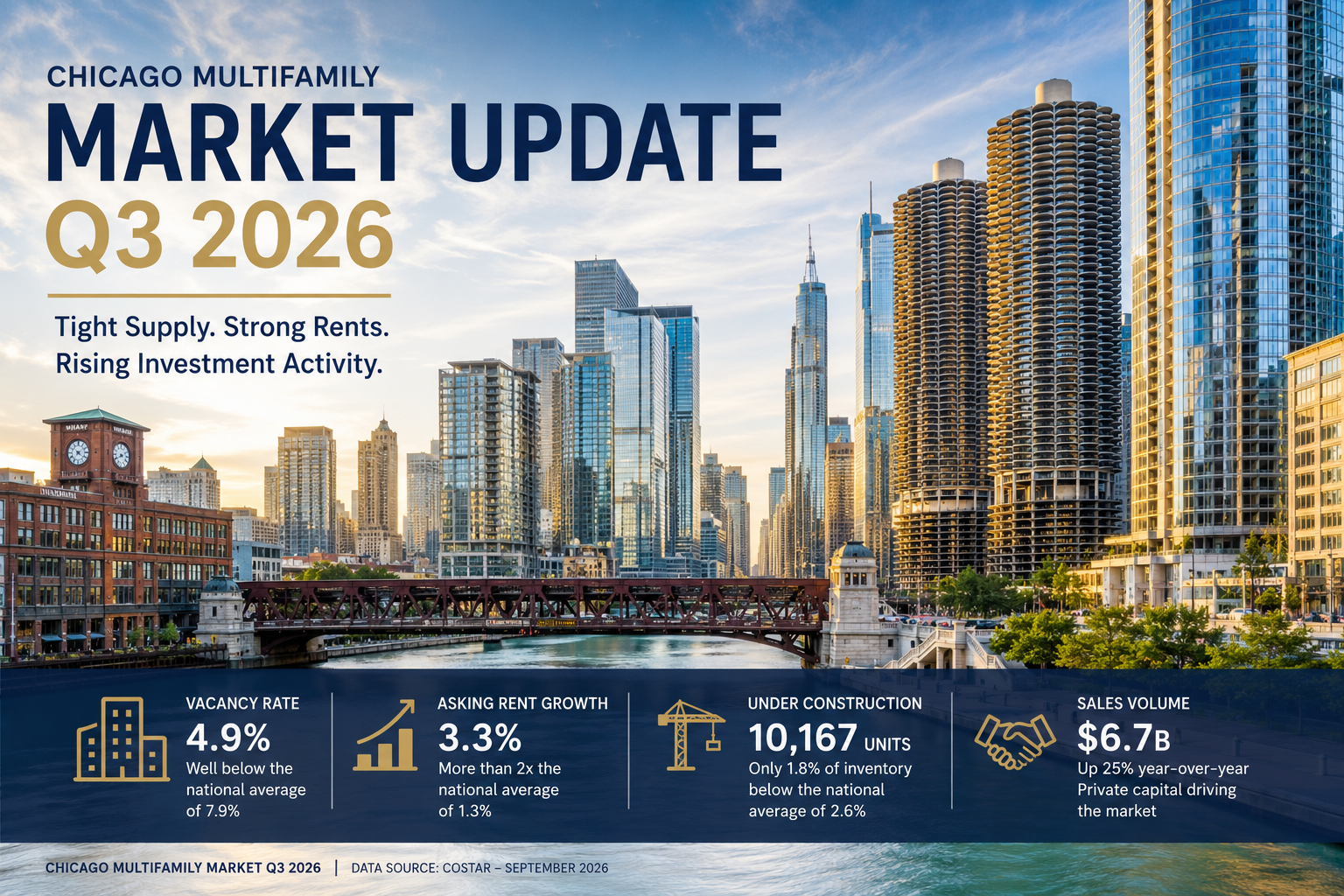
The Chicago multifamily market in Q3 2026 continues to outperform many major U.S. apartment markets.
Vacancy remains below 5%. Rent growth is more than twice the national average. New construction remains constrained. At the same time, multifamily sales volume has increased as private capital returns to the market.
For Chicago-area apartment owners, those trends are constructive—but they do not affect every property equally.
Submarket supply, in-place rents, operating expenses, property condition, and financing can materially change what buyers are willing and able to pay.
Chicago Multifamily Market Q3 2026: Key Metrics
According to CoStar's September 2026 Chicago Multifamily Market Report:
| Market Indicator | Current |
|---|---|
| Vacancy Rate | 4.9% |
| 12-Month Asking Rent Growth | 3.3% |
| Average Asking Rent | $1,975/unit |
| Effective Rent | $1,937/unit |
| 12-Month Absorption | 5,103 units |
| 12-Month Deliveries | 5,790 units |
| Under Construction | 10,167 units |
| Construction / Inventory | 1.8% |
| Trailing 12-Month Sales Volume | $6.7 billion |
Chicago's 4.9% vacancy rate remains well below the 7.9% national average, while annual asking-rent growth of 3.3% compares with approximately 1.3% nationally.
The central theme remains straightforward:
Chicago has enough renter demand to support growth, but not enough new construction to materially weaken existing apartment fundamentals.
Vacancy Remains Near Historic Lows
Chicago multifamily vacancy currently stands at 4.9%, compared with the market's historical average of approximately 6.9%.
Vacancy has edged higher over the past year, but that does not appear to represent broad weakness in stabilized properties.
Much of the increase comes from recently completed apartment communities still moving through initial lease-up. Stabilized vacancy has remained near 4.5%.
That distinction matters to owners of existing buildings.
New supply is entering the market, but recently delivered units are generally being absorbed without creating widespread vacancy pressure across stabilized inventory.
Approximately 5,100 units were absorbed during the past 12 months, exceeding Chicago's long-term annual average of approximately 4,700 units.
Demand has moderated from the unusually strong levels of 2024 and 2025, but it remains healthy by historical standards.
Chicago Rent Growth Continues to Outperform
Average Chicago asking rents are approximately $1,975 to $1,980 per unit, with annual asking-rent growth of 3.3%.
National rent growth is approximately 1.3%.
Chicago has ranked among the five strongest rent-growth markets among the nation's 40 largest multifamily markets since early 2023.
That strength is not evenly distributed.
Urban Chicago Leads Rent Growth
Downtown Chicago and the North Lakefront are currently among the strongest submarkets.
| Submarket | Asking Rent | Annual Growth | Vacancy |
|---|---|---|---|
| Downtown Chicago | $3,169 | 5.0% | 4.6% |
| North Lakefront | $2,249 | 5.0% | 3.6% |
| Aurora | $1,589 | 2.3% | 4.7% |
| Naperville/Lisle | $2,002 | 1.8% | 5.5% |
| North DuPage County | $1,810 | 2.3% | 4.6% |
| Northeast DuPage County | $2,040 | 2.5% | 6.0% |
| Southeast DuPage County | $1,886 | 1.6% | 4.8% |
CoStar's data shows urban effective-rent growth averaging roughly 4%, compared with approximately 2% in the suburbs.
This is one reason property valuation should begin at the submarket level rather than with a Chicago-wide average.
Property Quality Is Affecting Rent Performance
Rent growth also varies by asset quality.
During the past year:
- 4- and 5-Star properties: approximately 4.0% rent growth
- 3-Star properties: approximately 3.0%
- 1- and 2-Star properties: approximately 2.5%
Higher-quality apartments are also capturing a disproportionate share of leasing activity. Approximately 75% of recent absorption occurred in 4- and 5-Star properties.
For owners of older Class B and Class C properties, the takeaway is not necessarily to pursue luxury renovations.
The more useful question is whether targeted improvements can generate a measurable return through:
- Higher achievable rents
- Lower vacancy
- Better tenant retention
- Reduced maintenance
- Stronger buyer perception
A renovation only creates value when the resulting NOI justifies the investment.
Limited Construction Remains Chicago's Biggest Advantage
Chicago currently has approximately 10,167 multifamily units under construction, equal to only 1.8% of existing inventory.
That is below the national level of approximately 2.6%.
More importantly, the pipeline continues to shrink.
CoStar reports that construction starts have fallen approximately 30% during the past year and remain roughly 40% below the 10-year average.
Limited construction remains one of the primary reasons the Chicago multifamily market Q3 2026 continues to outperform many major apartment markets.
Approximately 5,800 units were delivered during the past 12 months.
Projected deliveries are
- 2026: approximately 6,100 units
- 2027: approximately 5,000 units
- 2028: approximately 4,500 units
High construction costs, financing constraints, and regulatory hurdles continue to make new apartment development difficult.
For owners of existing properties, that creates a meaningful competitive advantage.
Replacement cost remains high while future supply is limited.
New Supply Is Concentrated at the Top of the Market
Roughly 70% of apartments currently under construction are 4- and 5-Star units. Luxury communities represented more than 80% of 2025 deliveries.
That means new construction does not compete equally with every existing multifamily property.
A newly built Class A apartment community with extensive amenities may have limited direct competition with a well-located Class B suburban building offering substantially lower rents.
This segmentation can benefit existing owners, particularly where replacement rents are materially above current in-place rents.
Suburban Chicago Has Very Different Supply Conditions
One of the most important points in the current report is the variation between suburban submarkets.
Aurora
Aurora currently has approximately 566 units under construction, equal to roughly 11.1% of existing multifamily inventory.
Vacancy remains approximately 4.7%, and asking rents have increased about 2.3%.
The existing fundamentals remain solid, but owners should watch lease-up activity closely because Aurora's construction pipeline is unusually large relative to its current apartment inventory.
Naperville/Lisle
Naperville/Lisle has approximately 306 units under construction, equal to roughly 1.5% of inventory.
Current asking rents average approximately $2,002 per unit, with 5.5% vacancy.
DuPage County
North DuPage currently has minimal new construction and a vacancy rate of approximately 4.6%.
Northeast DuPage has approximately 473 units underway, while Southeast DuPage has approximately 138 units under construction.
These differences reinforce why a Chicago multifamily property should never be underwritten solely from metro averages.
Chicago Landlords Are Using Few Concessions
Another measure of market strength is concession activity.
Only about 1.5% of Chicago multifamily properties currently offer concessions, compared with roughly 3.5% nationally.
In markets with excessive supply, landlords often compete through free rent, reduced deposits, or other incentives.
Chicago's low concession rate indicates that most landlords still have sufficient pricing power to maintain rents without aggressively discounting occupancy.
Chicago Multifamily Sales Volume Reaches $6.7 Billion
The capital markets are also improving.
Chicago multifamily sales volume reached approximately $6.7 billion during the trailing 12 months, representing a roughly 25% year-over-year increase.
National sales volume increased approximately 5% during the same period.
That is important for owners considering a disposition.
Property values require more than strong operating fundamentals. Sellers also need active buyers with equity, financing, and confidence in future performance.
Chicago's buyer pool is becoming more active.
Private Investors Are Driving the Market
Private buyers historically represented approximately 60% of Chicago apartment transactions.
During the past year, their share increased to more than 70%, while institutional participation declined to approximately 20%.
This is particularly relevant to privately owned apartment properties.
Most Chicago and suburban multifamily buildings do not compete directly with $100 million institutional transactions. Their likely buyer pool consists of private investors, family offices, syndicators, and 1031 exchange buyers.
An expanding private-capital buyer pool can improve:
- Market liquidity
- Competitive bidding
- Price discovery
- Transaction certainty
Multifamily Values Are Rising Without Major Cap-Rate Compression
Perhaps the most important capital-markets trend is that the average price per unit increased approximately 10% year over year, while cap rates remained relatively stable.
That suggests property income is doing more of the work.
For owners, this is an important distinction.
Value does not require cap rates to return to 2021 levels.
If NOI increases while cap rates remain stable, property value can still rise.
Chicago Multifamily Cap Rates by Property Quality
CoStar's current modeled market cap rates are approximately
| Property Quality | Market Cap Rate |
|---|---|
| 4 & 5 Star | 5.9% |
| 3-Star | 6.6% |
| 1 & 2 Star | 7.5% |
These figures are useful benchmarks, but they are not property-specific valuation conclusions.
Actual pricing depends on rent levels, operating expenses, location, condition, taxes, deferred maintenance, unit mix, and available financing.
What Should Chicago Multifamily Owners Do Now?
The Q3 2026 market data supports several practical conclusions.
Review Rent Position
Compare every unit against current competitive rents.
The relevant question is not simply whether rents can increase. It is whether the increase is sustainable after considering turnover, condition, and competing inventory.
Protect NOI.
In a relatively stable cap-rate environment, NOI is one of the most direct drivers of value.
Review:
- Property taxes
- Insurance
- Utilities
- Repairs and maintenance
- Management
- Collections
- Vacancy
- Loss-to-lease
Prepare Financial Records Before a Sale
Buyers and lenders need credible historical information.
Owners considering a sale should have a current rent roll, trailing operating statement, tax bills, insurance costs, utility history, and major capital improvements organized before marketing begins.
Evaluate Value Using Current Data
Owners relying on valuations completed during 2023 or 2024 may be working from outdated assumptions.
Rents, transaction liquidity, and buyer activity have changed materially.
A current valuation can establish whether the best strategy is to sell, refinance, hold, or make operational improvements before going to market.
Chicago Multifamily Outlook for Late 2026
The Chicago multifamily market in Q3 2026 remains supported by an unusually favorable supply-demand balance.
Vacancy remains below 5%.
Rent growth is running well above the national average.
Construction activity continues to decline.
Concessions remain limited.
Investment sales volume is rising.
Private capital is increasingly active.
There are also risks.
Population growth has moderated, financing remains relatively expensive, and Cook County property-tax uncertainty continues to affect underwriting.
The market should therefore be viewed as constructive rather than indiscriminately bullish.
CoStar expects apartment deliveries to remain below historical norms through 2028. If renter demand remains reasonably stable, Chicago's limited construction pipeline should continue to support apartment occupancy and rent growth.
For property owners, the opportunity is increasingly asset-specific.
Determine Your Property's Current Market Position
Market reports establish direction. They do not establish the value of an individual apartment building.
For owners, the Chicago multifamily market Q3 2026 remains constructive, but value is increasingly determined by individual property performance and submarket conditions.
A current Broker Opinion of Value should reconcile:
- In-place rents
- Market rents
- Trailing operating performance
- Normalized expenses
- Property taxes
- Comparable multifamily sales
- Current cap rates
- Buyer financing
- Property condition
- Submarket supply and demand
For Chicago-area multifamily owners considering a sale, refinance, estate-planning decision, or portfolio strategy, a current property-level analysis can establish probable market pricing and identify opportunities to strengthen value before going to market.
https://creconsult.net/chicago-multifamily-market-q3-2026/?fsp_sid=2925